
The War brides of WWii
Millions of men fell in love while oversees, bringing their wives home took an act of Congress
War Brides of WWII
During World War II, millions of American servicemen were deployed across Europe, the Pacific, and beyond. Amid the chaos of war, many found love with local women—creating a remarkable chapter in history known as the “war brides” phenomenon. These women, from war-torn countries and former enemy territories alike, married U.S. soldiers and faced the daunting task of building new lives across the ocean. Their stories blend romance, resilience, cultural clash, and the reshaping of American immigration policy.
How Many American Men Married Foreign Women?
Exact figures are elusive due to the chaos of wartime record-keeping, but historians estimate that between 1942 and 1952, roughly one million American soldiers married foreign women from about 50 different countries.
Breakdowns by region include:
United Kingdom: Around 70,000 British “GI brides.”
Continental Europe: Estimates of 150,000–200,000, including significant numbers from France, Italy, Germany (14,000–20,000), and others.
Australia and New Zealand: About 15,500 from Australia and 1,500 from New Zealand.
East Asia: 50,000–100,000 or more, primarily from Japan (around 50,000 during/after the occupation), the Philippines, and later Korea. Overall Asian migration related to these marriages reached higher numbers in the following decades.
By some accounts, nearly 300,000 war brides and their dependents arrived in the U.S. under the relevant acts by the end of 1948.44 These numbers represent one of the largest waves of female immigration in U.S. history at the time and had lasting demographic and cultural impacts.
Many marriages happened quickly—fueled by the urgency of war, separation, and the soldiers’ relatively high pay, charm, and access to scarce goods like chocolate, stockings, and cigarettes. British women often described GIs as “overpaid, oversexed, and over here,” a mix of resentment and attraction. In liberated Europe, Americans symbolized hope and heroism. In occupied Japan and Germany, relationships formed despite official discouragement and cultural barriers.
Personal Account
Sgt. Albert Daube, an German born Jew, escaped Germany in the 30’s and became an American citizen before joining the Army. While stationed in Europe, he met Pearl Jacobs would soon become his wife.
“Just days after D-Day, Daube joined his unit, the 368th Engineer Regiment, in France. According to son David Daube, Albert proposed, “if I'm able to return alive, let's get married.” As soon as the war ended, Daube requested leave to marry his sweetheart in England. After a small wedding in a courthouse ceremony and two-day honeymoon in London, Albert had to return to his unit and to the United States, forced to leave his non-citizen bride behind. Discharged from the Army in October 1945, Albert had some time to wait before his wife could join him.”1
Pearl set sail on the Queen Mary, a ship that carried hundreds of thousands of other war brides. She and Albert were happily married for 68 years before her death in 2013. Pearl volunteered at the National WWII Museum for many years and is remembered for her service and kindness.
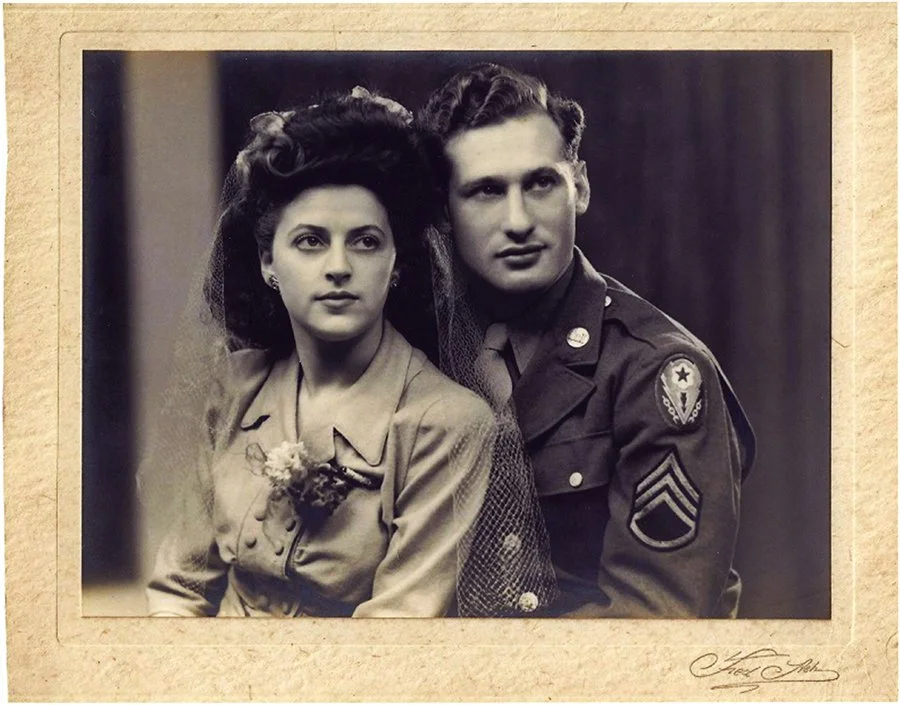
Newlyweds Pearl and Albert Daube, Courtesy of the Family of Pearl and Albert Daube via the National WWII Museum
The Process: From Overseas Romance to American Shores
Bringing war brides home was no simple matter. U.S. immigration laws, particularly the restrictive Immigration Act of 1924 (with its national origins quotas and Asian exclusion provisions), created massive barriers. Many couples married overseas but faced long separations while navigating bureaucracy.
Key legislative solution: The War Brides Act of 1945 (Public Law 271, signed December 28, 1945). This act expedited admission for alien spouses and minor children of U.S. armed forces members who served in WWII. It granted them non-quota immigrant status, exempting them from standard immigration limits and providing free transportation. It was later extended and supplemented by the Alien Fiancées and Fiancés Act of 1946. Amendments in 1946–1947 helped include more Asian spouses.
Typical steps for war brides:
Marriage overseas: Often required military approval, waiting periods (especially for German or Japanese brides), and screenings.
Application: Register with the U.S. consul in the home country, provide proof of marriage, medical exams, and background checks.
Visa and approval: Under the Act, they received priority processing as non-quota immigrants.
Travel: Most sailed on converted troop ships (e.g., the SS Argentina, which carried the first major group of 452 British brides and 173 children in January 1946). Journeys could be rough, lasting days to weeks.
Arrival and adjustment: Upon reaching U.S. ports, they underwent further processing. Many faced culture shock, family separation, and occasional prejudice (“They stole our boys”). Some joined “war bride clubs” for support. Citizenship pathways followed after residency periods.
The Queen Mary
As many as 29 ships were converted to carry the wives and children of GIs. Great care was taken to firstly give priority to wounded soldiers, and secondly, provide enough support for the women and children. These ships needed to be equipped with nurseries, hospitals, beds, and all the things needed to provide safe and comfortable transportation for weeks at sea.2 One of the most well known ships used to carry the brides was the Queen Mary.
The RMS Queen Mary was a legendary British ocean liner built by Cunard White Star Line. Launched in 1934 and entering service in 1936, she was one of the most luxurious and fastest passenger ships of her era, holding the Blue Riband for the fastest transatlantic crossing.
At the outbreak of World War II in 1939, the Queen Mary was requisitioned by the British Admiralty. She was painted battleship grey, stripped of her lavish interiors (many fittings were removed and stored for safekeeping), and converted into a troopship in Sydney, Australia, in 1940.
During the war, she carried hundreds of thousands of Allied troops (including Australian, New Zealand, and American soldiers) across the Atlantic and other routes, playing a vital role in the war effort. By September 1946, she had transported over 765,000 military personnel.
After the end of hostilities in 1945, the Queen Mary was repurposed again — this time to reunite families. Minor alterations were made to better accommodate women and children (such as improved facilities for mothers and babies).
She became one of the primary ships in the War Bride transport operation (sometimes called Operation Diaper due to the large number of infants). Between February 3 and May 19, 1946, she completed six dedicated war-bride voyages, carrying a total of 12,886 European brides and their children to the United States and Canada
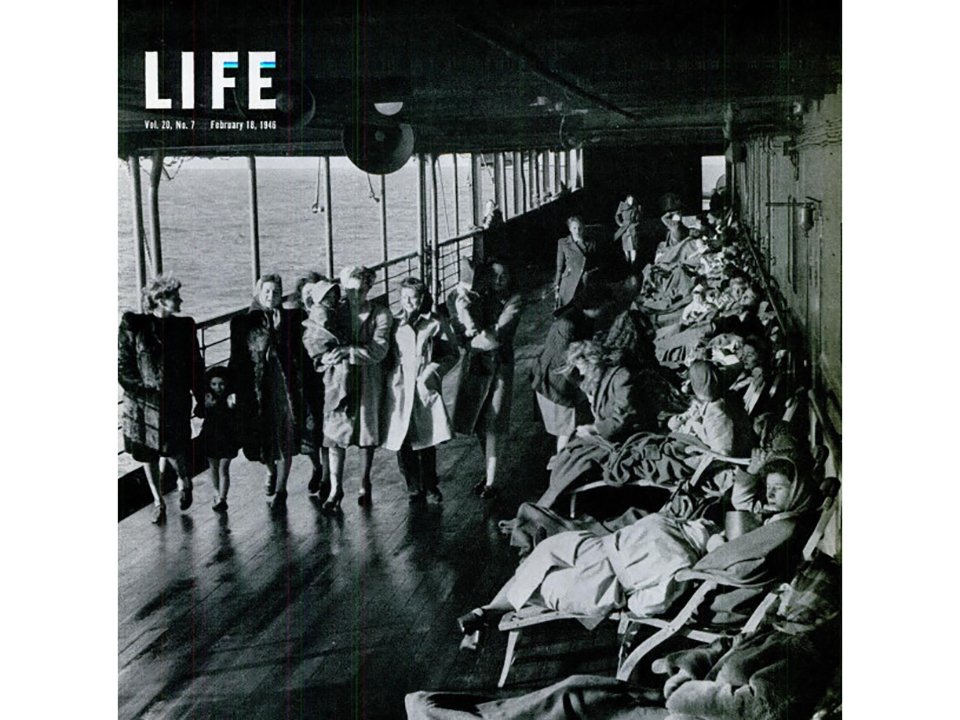
Life covered the SS Argentina war brides in its 2/18/46 issue. Courtesy of Life Magazine.
History Video Provided by The Queen Mary on Youtube
Life After Arrival: Triumphs and Trials
Challenges varied: British brides often integrated more easily due to shared language and alliances. Japanese and other Asian brides confronted racial prejudices and miscegenation laws in many states, yet their stories helped erode barriers, contributing to broader immigration reforms like the 1952 McCarran-Walter Act.
Many war brides thrived, raising families in the postwar boom and contributing to American society. Others struggled with homesickness, language barriers, or adjusting to suburban life far from their roots. Their children grew up in a more diverse America, and the marriages normalized interracial and interethnic relationships over time.
Oral histories reveal a common theme: the hardest part was often saying goodbye to family, knowing transatlantic travel was rare and expensive. Yet, for many, the promise of peace, opportunity, and love outweighed the risks.
A Lasting Legacy
The WWII war brides represent a human face of wartime alliances and the enduring power of love amid conflict. Their migration not only reunited families but also challenged and changed U.S. immigration policy toward family reunification over strict quotas. Today, millions of Americans can trace their ancestry to these courageous women.
War Brides Today
“War Briding” was not a phenomenon unique to WWII.As long as men are stationed oversees, they will surely find a local woman to fall in love with. The military has a number of policies in place to assist this process.
Korean War - 6423 Brides
Vietnam War - 8040 Brides
Iraq/Afghanistan - 2000 Brides
One interesting story from military love is that of Nan Stevens, mother of TV show host Joanna Gaines. Jerry Stevens was stationed in South Korea from 1969-1971 where he met Nan. The two fell in love and Nan joined Jerry in San Francisco when she was just 19. The two moved to Kansas and were married for 50 years. Their daughter Joanna, would become a TV show host and successful business owner.
If you have a war bride in your family tree, consider preserving her story through oral history, photos, or genealogy records—it’s a vital piece of both personal and national. You can do this by clicking the home page and filling out the form.
Sources drawn from historical records, the National WWII Museum, Wikipedia summaries of scholarly estimates, and period accounts.