
Camp Phillips Kansas
Very little is left of the base which once trained 100,000 men for war in Europe
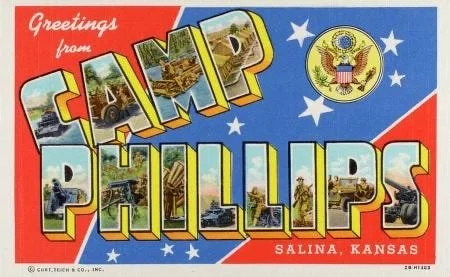
Camp Phillips Post Card
The Critical State of Things
When the United States was pulled into World War II in December 1941, the federal government faced an existential crisis: it had a massive population, immense industrial capacity, but virtually no military infrastructure. To survive a global war on two fronts, the nation had to rapidly transform from a peaceful, isolationist country into a lethal global superpower.
In 1939 the U.S. Army had roughly 190,000 active-duty soldiers and an estimated 200,000 more soldiers in the National Guard. This made it the 17th largest army in the world, smaller than the military of Portugal. The pre-war military was abysmally small and keep in mind, there was no United States Air Force yet. That did not start as an independent branch in 1947. 100% of all land base air assets were rolled up in the Army Air Corp at this time. To put this in perspective, the US currently has 545,000 active Army troops with an additional roughly 500,000 in Reserve and National Guard. We also have similar numbers in the Navy and USAF as well as a few hundred thousand in the USMC, Coast Guard, and Space Force.
When The Japanese bombed Pearl Harbor, it was clear the United States needed to beef up its military, and it needed to happen yesterday. There was no way that America could fight both the Japanese and Germans in a two-front war without an exponential increase in manpower. The decision was made to recruit and draft as many men as possible, and train them as quickly as possible. To do this, training bases were needed.
The pre-war days were full of stories of an underfunded and undertrained Army, stories that would surely make the US Army an laughing stock on the world stage. Training maneuvers were an embarrassment; infantrymen practiced with wooden "guns" and drove civilian trucks painted with the word "TANK" because actual equipment did not exist. That would soon change.
Rapid Growth
In 1940 the US had roughly 20 main Army bases located in the continental US. By 1945 the number of main bases would swell to nearly 345 main bases, 116 sub-bases, and 322 auxiliary fields across the country.
By 1941, the Selective Training and Service Act began pulling hundreds of thousands of men into the draft. Following the attack on Pearl Harbor, that draft turned into a tidal wave. The military leadership calculated that to win the war, between 8 and 11 million men would need to be mobilized, processed, clothed, and trained.
The existing, sleepy peacetime bases like Fort Bragg or Fort Hood couldn’t handle a fraction of this volume. The War Department determined it needed to construct hundreds of entirely new military bases from scratch—ultimately building over 240 major army training camps, alongside thousands of smaller airfields and depots, to process the massive wave of humanity.
Army officials scoured the country looking for any and all open land that could be purchased cheaply. The War Department didn’t pick Central Kansas by accident. The selection of Saline County followed a strict, cold, scientific formula managed by the Army Corps of Engineers:
Inland Safety: Fear of Axis long-range bombers or coastal naval shelling meant that the most crucial, large-scale training centers had to be located deep within the American interior. Kansas was effectively untouchable by enemy aircraft.
Topography and Space: A “Triangular Division” required immense tracts of open, flat land to conduct maneuvers, fire heavy artillery, and drive armored divisions without colliding with civilian cities. The wide-open Kansas prairie provided tens of thousands of continuous, unobstructed acres.
The Railroad Nexus: An army division cannot walk to the front lines. Salina, Kansas, was a massive hub for the Union Pacific and Santa Fe railroads. Troops could be shipped into the camp via rail, and fully trained divisions could be packed onto trains and sent straight to coastal ports for deployment.
The military found exactly the blank canvas it needed in Saline County, Kansas. In a matter of months, a quiet patchwork of family farms was transformed into a massive, booming “pop-up city” known as Camp Phillips.
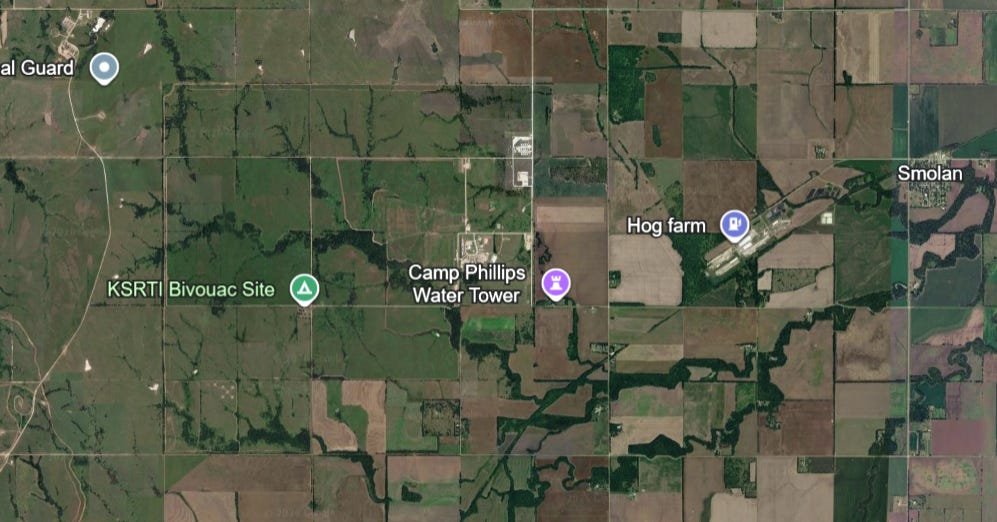
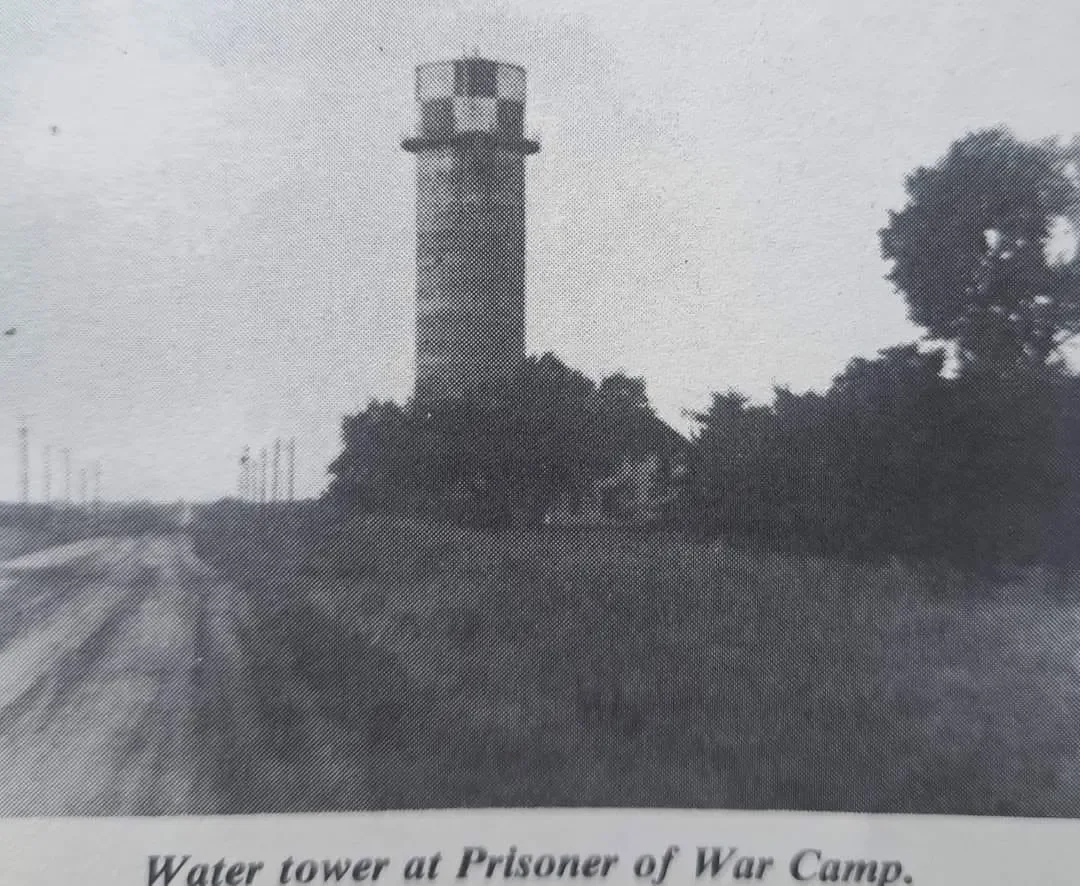
The base is now gone and there is almost no sign it ever existed with exception of a single water tower and a few concrete munitions storage areas.
Procurement of Land
The procurement of the land was a brutal, efficient exercise of federal power. In May 1942, the U.S. War Department officially requisitioned 45,000 acres (roughly 69 square miles) of fertile farmland southwest of Salina and near the tiny community of Smolan.
Under the War Powers Act, the government used eminent domain to condemn the territory. This immediately displaced 107 farm families, many of whom had tilled that soil for generations.
The government valued the land at rock-bottom, pre-war market rates. Families were given as little as 15 days to pack up their lives, sell their cattle at steep losses, and leave. There was no time for sentimentality; the global war clock was ticking.
Uniformity
What happened next was a marvel of American engineering and industrial might. Construction began in late May 1942. A workforce of over 9,000 civilian laborers descended on the area, working 24 hours a day, 7 days a week under floodlights.
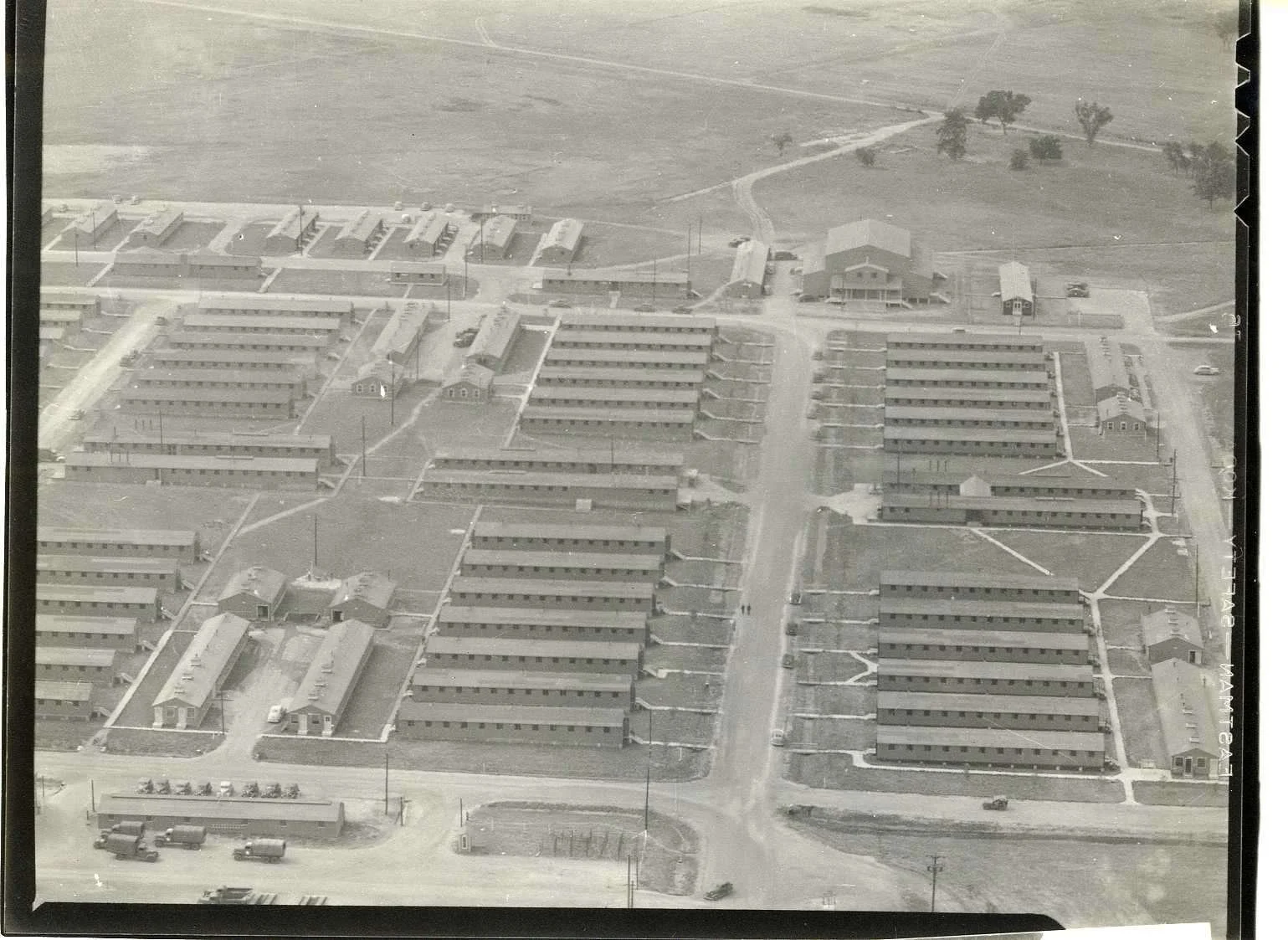
Camp Phillips became part of a vital military experiment. It was constructed using the Army’s standardized Series 700 blueprint. Instead of unique architecture, the military designed highly uniform, modular, “mobilization-type” buildings.
The Blueprint: These buildings were made primarily of wood, tarpaper, and gypsum board. They were designed to be erected like giant Lego or Erector sets.
The Speed: Carpenters could raise a two-story, 63-man barracks building in less than 48 hours.
The Scale: In just four months, workers built a fully functioning city out of the dirt. By the time the U.S. Army officially took the keys, the base featured over 3,500 structures, including hundreds of barracks, 30 warehouses, five movie theaters, 100 rec halls, 11 chapels, and a massive 1,726-bed station hospital.
The incredible speed and efficiency of the Series 700 layout at Camp Phillips served as a structural blueprint for other bases across the American South and Midwest. The lesson learned in Kansas—that a civilian workforce could build an entire military city in 120 days—was duplicated across the nation to keep pace with the draft.
The "Triangular Division" Crucible
At its peak, Camp Phillips housed 45,000 troops and 5,000 civilian employees at any given moment. The camp was named in honor of Colonel William A. Phillips, a Civil War officer and a pioneer founder of Salina.
The concept of the camp was to train Triangular Divisions—streamlined, fast-moving tactical units built around three infantry regiments. This layout replaced the old, bulky World War I “Square Division.”
To prepare these men for combat, the camp was an all-in-one environment. Surrounding the living grid were intensive target ranges, live-fire artillery fields, a 60-acre tank repair depot, and high-security ammunition storage bunkers. Troops lived under simulated combat conditions, enduring the scorching, windy Kansas summers and freezing, mud-slicked plains winters.
The Build: Structural Anatomy of a Pop-Up City
The construction numbers behind Camp Phillips sound like a modern industrial fantasy. The civilian workforce built roughly 3,500 structures in a matter of 120 days.
Because the base relied on the military’s standardized Series 700 blueprint, every single structure was built out of minimal materials designed for temporary use (the War Department estimated a structural lifespan of just 5 to 10 years).
The Composition of the Buildings
Forget bricks, concrete, or structural steel. The buildings at Camp Phillips were composed almost entirely of:
Rough-cut, partially cured 2x4 lumber.
Three-quarter-inch wood sheathing or gypsum board for walls.
An exterior wrap of pitch-black tarpaper or asbestos-cement shingles to keep out the rain.
Types of Structures on the Base
The camp grid was divided into highly organized, hyper-repetitive zones:
The 63-Man Barracks: The backbone of the camp. These were long, austere, two-story rectangular wooden boxes. They featured rows of tightly packed metal cots on both floors, heated by a single, coal-burning potbelly stove at each end of the building.
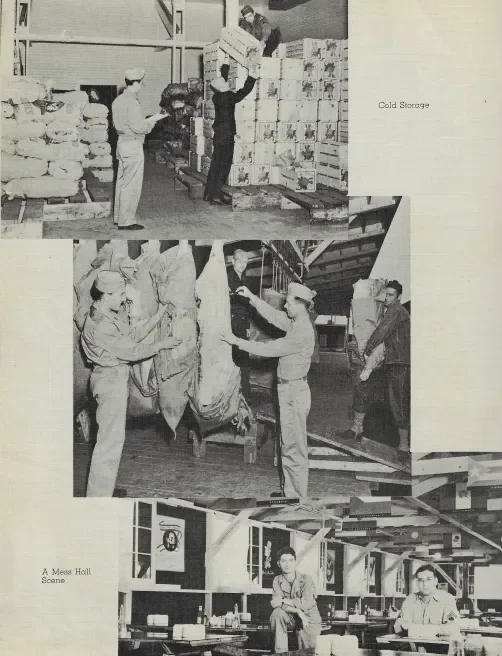
Mess Halls: Large, single-story T-shaped or H-shaped structures designed to feed entire companies simultaneously. They were built around industrial, coal-fired cookstoves and long, raw wooden picnic tables.
The Post Exchanges (PXs) and Day-Rooms: The commercial and social hearts of the base. These structures contained basic general stores where soldiers could buy toiletries, sewing kits, and local souvenirs, alongside “day-rooms” later modified to dispense low-alcohol beer.
The Sprawling Hospital Complex: A massive, interconnected web of nearly 90 single-story pavilions linked by covered wooden walkways, designed to isolate contagious diseases and treat injuries from live-fire training.
Daily Life: The “Austerity and Dust” Experience
If you ask a veteran who trained at Camp Phillips what they remember most, the answer is invariably the same: the weather, the mud, and the drafty barracks.
Because the camp was constructed at breakneck speed with cheap, unseasoned wood, the buildings quickly began to warp, shrink, and settle. This created an environment where the line between the harsh Kansas elements and indoor living was paper-thin.
The Thermal Whiplash
Daily life was dictated by extreme Central Kansas seasons.
The Freezing Winters (1942–1944): The gaps between the shrinking exterior 2x4 sheathing allowed freezing winds to howl directly through the barracks walls. Units like the 250th Station Hospital recorded that personnel spent hours simply trying to patch cracks to keep their quarters liveable. Water could only be reliably accessed in three centralized buildings (the mess and two latrines) because lines to individual barracks regularly froze solid. Soldiers slept under stacks of heavy wool blankets, keeping their uniforms on just to survive the night.
The Scorching Summers: In July and August, the tarpaper-wrapped barracks transformed into literal ovens. Without insulation or air conditioning, indoor temperatures routinely soared past 100°F.
Dust, Mud, and the Obstacle Course
Before the camp’s 54 miles of roads were fully paved, the movement of 45,000 men and heavy military vehicles churned the topsoil into a brutal environmental hazard.
During dry spells, a choking, thick layer of Kansas dust hung over the entire grid, infiltrating clothing, beds, and mechanical equipment. When the plains rains arrived, the dust dissolved into a deep, glue-like prairie mud that threatened to swallow boots and stall trucks.
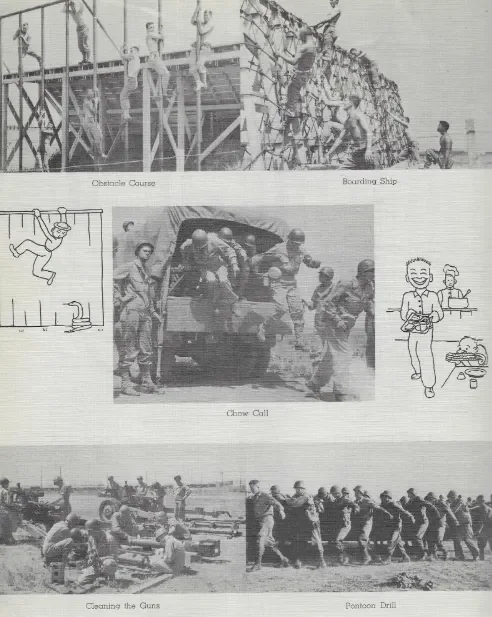
A standard day began before dawn with reveille, followed by hours of close-order drill in the mud. Soldiers then faced grueling physical testing, including navigating intensive obstacle courses and practicing ship-boarding maneuvers by climbing giant cargo nets draped over wooden scaffolding out in the middle of the dry prairie fields.
Keeping Sanity: Mail, Movies, and the PX
To prevent morale from cratering in these rugged conditions, the camp relied heavily on its uniform entertainment infrastructure.
Soldiers swarmed the five movie theaters on base to catch newsreels of the war and Hollywood comedies. The PX sold pillow shams embroidered with the camp’s name, which soldiers mailed back to sweethearts and parents.
For many young men, life at Camp Phillips was their first time away from home, defined by a strange paradox: the suffocating lack of privacy inherent to a 63-man communal barracks, contrasted against the deep, isolating loneliness of being stationed thousands of miles away from everything they knew, preparing for a war across the Atlantic.
Unique Wartime Stories
Over 150,000 soldiers passed through Camp Phillips, yielding fascinating chapters of human history:
The 960th Quartermaster Service Company
Camp Phillips was the activation site for the 960th Quartermaster Service Company, a segregated African-American unit. These men trained intensely in the harsh Kansas elements, learning night patrolling and logistics. When deployed to Europe, they faced some of the war’s most grim and emotionally taxing work—handling and burying thousands of American casualties at the Netherlands American Cemetery. They were ultimately decorated by the Ninth Army for their superior execution of duty.
The Axis Prisoners of War
When stateside infantry training slowed down in late 1944, Camp Phillips was converted into a major Axis POW camp. Nearly 7,000 German and Italian prisoners were detained there. Because local Kansas men were away fighting, a severe labor shortage threatened the American food supply. The government leased these POWs out to local farms. For months, German soldiers worked side-by-side with Kansas families harvesting wheat, creating bizarre moments of cultural crossover in the American heartland.
The prisoners were housed inside the very same structures that American GI’s had just vacated. Because Camp Phillips was built using the rigid, standardized Series 700 military blueprint, the POW layout was highly secure yet functional:
The Enclosure: Portions of the 3,500-building camp were retrofitted with heavily guarded, double-barbed-wire perimeter fences and tall wooden guard towers equipped with searchlights.
Quarters: Prisoners slept in the standard, austere two-story wooden barracks. Just like the American soldiers before them, they relied on coal-burning potbelly stoves for heat during the bitter, drafty Kansas winters.
Segregation: Under the terms of the Geneva Convention, military authorities meticulously screened the incoming prisoners. Hardcore, unrepentant Nazi zealots and SS officers were filtered out and sent to higher-security isolation facilities (such as Alva, Oklahoma), ensuring that the general population at Camp Phillips consisted mostly of conscripted regular soldiers willing to cooperate.
The Labor Shortage and Agricultural Lease Program
The presence of 7,000 enemy soldiers in Saline County solved a severe domestic crisis. By late 1944, the local agricultural workforce had been completely depleted. Local Kansas farmboys were overseas fighting, leaving millions of acres of vital wheat, corn, and root crops at risk of rotting in the fields.
Under the Emergency Farm Labor Program, the U.S. government began leasing out the cooperative, non-commissioned Axis prisoners to local civilian farms.
The Labor Economy: Private farmers applied to the camp commanders for labor details, paying the U.S. government the standard local minimum wage for civilian labor (usually around 40 to 50 cents an hour per worker). The government kept the majority of these funds to offset the cost of running the camp, but the prisoners were paid a small daily stipend—usually 80 cents in “canteen coupons”—which they could spend at the camp store on tobacco, toiletries, or snacks.
Every morning, trucks departed the gates of Camp Phillips to drop small squads of German and Italian prisoners off at farms across Saline County. For months, enemy combatants worked shoulder-to-shoulder with Kansas families, assisting with harvesting, clearing land, and tending livestock.
Daily Life and Cultural Crossover
Because the hard-line political extremists had been screened out, the day-to-day atmosphere within the Camp Phillips POW compound was surprisingly orderly and peaceful.
Life Behind the Wire
To occupy their time when not working the fields, the prisoners organized their own complex camp ecosystem. Following Geneva Convention rules, they were permitted to manage internal recreation. They formed soccer leagues, put together musical bands, organized theatrical performances, and even established their own camp newspapers.
Interaction with Kansans
The physical proximity of local farmers to the prisoners yielded fascinating, deeply human oral histories. While regional civilians were initially terrified of having thousands of enemy troops in their backyards—fearing escapees or sabotage—the daily reality of agricultural labor quickly eroded that tension.
Local farm wives frequently disregarded strict military regulations against fraternization, choosing to cook massive, hearty midwestern lunches for the working prisoners. Many German soldiers, recognizing that the war was lost and they were being treated humanely, openly expressed relief at being safely interred on the quiet Kansas prairie. In many cases, these interactions forged genuine friendships that resulted in letters being exchanged between Kansas farm families and former POWs long after the men were repatriated to a devastated post-war Europe.
Closure and Dismantling
The POW camp at Camp Phillips operated until the formal conclusion of the war in 1945. Following the surrender of Nazi Germany in May 1945, the systematic processing and repatriation of the prisoners began.
By June 1945, the military commenced the full-scale dismantling of the base. The 7,000 prisoners were gradually transferred to coastal ports to be shipped back across the Atlantic. By 1946, the barracks were empty, the fences were torn down, and the vast grid was sold off or reclaimed by the wild grasses and sunflower fields of Central Kansas, leaving behind almost no physical traces of the massive wartime prison
Destination: Where Did They Go to Fight?
The men who crawled through the mud at Camp Phillips weren’t trained for Pacific jungle warfare; they were specifically conditioned for the open, muddy, and urban terrain of the European Theater of Operations (ETO).
Four major Army Infantry Divisions completed their final, grueling training cycles at Camp Phillips before boarding trains for the East Coast:
The 44th Infantry Division: Deployed to France, they broke through the Maginot Line and successfully defended the key city of Strasbourg against fierce German counterattacks.
The 79th Infantry Division: Landed at Utah Beach just days after D-Day, fighting through the bloody hedgerows of Normandy and playing a central role in capturing the vital port of Cherbourg.
The 80th Infantry Division: Became a spearhead for General George S. Patton’s famous Third Army, racing across France and helping to punch through the German lines during the brutal Battle of the Bulge.
The 94th Infantry Division: Assigned to contain bypassed German submarine bases on the French coast before moving inland to breach the formidable Siegfried Line.
Base Closure and Modern Legacy
The lightning-fast lifespan of Camp Phillips concluded almost as quickly as it began. As the tide of WWII swung decisively in the Allies’ favor, the Army consolidated its stateside training operations.
On October 27, 1944, Camp Phillips was officially deactivated. Following the departure of the POWs at the war’s end, the process of dismantling the base began in June 1945.
Reclaiming the Land
Rather than leaving a ghost town, the government declared the camp’s materials surplus:
Barracks to Classrooms: To handle the massive wave of returning veterans utilizing the G.I. Bill, 440 barracks were dismantled and shipped to midwestern universities to serve as emergency student housing.
Local Repurposing: Dozens of other buildings were sold to local farmers, who hauled them away to become hay barns, equipment sheds, and garages that still dot the Central Kansas landscape today.
Today, a significant portion of the old Camp Phillips ground is occupied by the Smoky Hill Weapons Range. Operated by the Kansas Air National Guard, it stands as the largest and busiest air-to-ground bombing training range in the Air National Guard system—a quiet continuum of the vital combat preparation that began in the Saline County dirt more than eighty years ago.
Further Reading:
Photos can be found in the Official Camp Phillips photo book produced by the Army in the 1940’s. Original copies are rare but a PDF version can be found HERE.
If you are the kind of person who wants all the facts, you must read CAMP PHILLIPS World War II Army Post: A National Success Story written by Royal Oakes, US. Army WWII.
Drafted at age 18, Royal was stationed at camp Phillips and trained as a tank driver before shipping off to Europe. In 1986 Royal decided the story of Camp Phillips needed told, and he was the man for the job. Thanks to Royal, we have access to this interesting piece of military history.